Built Once, Shaped for Every Channel
Titles, images, variants, and attributes go to each channel in the exact shape it asks for. Nobody types the same product into five systems.
Ecommerce development for DTC and B2B brands on Shopify, Adobe Commerce, BigCommerce, WooCommerce, and Commerceflo, with AI agents that keep channels, stock, and orders in sync.
FactoryJet is an ecommerce development company for DTC and B2B brands in the United States, and an AI development company that builds the agents on top. We design, build, implement, and support stores, B2B portals, AI agents, and the websites and search presence around them. You own and run everything we build.
Most multichannel problems are data problems. When your store, Amazon, Walmart, TikTok Shop, and B2B portal each keep their own copy of stock, you oversell. We build one catalog, one live inventory, and one order queue under every channel.
About 70% of online carts are abandoned before checkout. The store you sell from has to load fast and be easy to buy from, or the traffic you paid for leaks out. Baymard Institute ↗
16.9% of US retail sales now happen online, and visits to US retail sites from AI tools like ChatGPT rose 1,200% between July 2024 and February 2025. Buyers now ask an assistant what to buy. US Census ↗ Adobe Analytics ↗
The AI agents we build are task agents, not chatbots. They list new products in each marketplace's format, fix suppressed listings, reprice, and reconcile feeds on your live data, then hand the exceptions to your team.

Each marketplace, storefront, and B2B portal wants its own listings, its own stock feed, and its own order export. Run them as separate systems and the bill arrives as oversold stock, suppressed listings, and hours spent matching numbers by hand.
Marketplace sellers lose 36% of the working week to manual tasks: updating listings, fixing errors, and adjusting prices.
of marketplace sellers still rely on spreadsheets or internal tools for listings and inventory, while selling on six marketplaces on average.
is lost across retail worldwide each year to out-of-stocks and overstocks, according to IHL Group.
The cleaner shape is one catalog, one inventory, and one order engine, with agents keeping every channel in sync.
See what we build under every channel ↓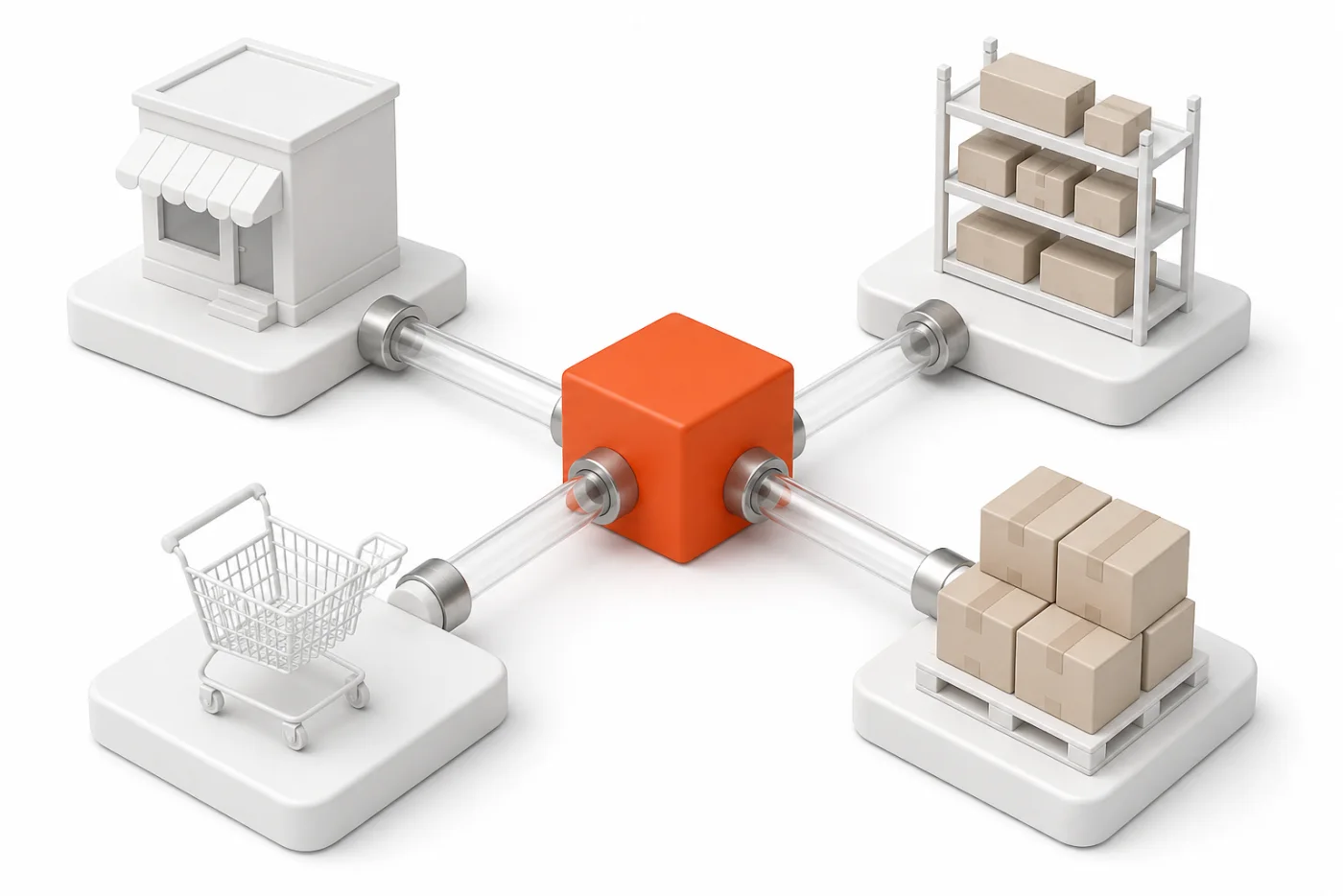
The architecture under omnichannel selling. One catalog, one live inventory, and one order engine that your store, marketplaces, point of sale, and B2B portal all read from, instead of each keeping its own copy. Omnichannel describes what the customer sees. Unified commerce is what keeps it true: a unit sold on Amazon is gone from Shopify and the wholesale portal moments later, and nobody re-keys a product five times. If a vendor's "omnichannel" setup still needs a nightly spreadsheet to reconcile, it isn't unified.
The fix is one source of truth that every channel reads, built on the platform you already run or the one that fits you better. We build it on Shopify, Adobe Commerce (Magento), BigCommerce, WooCommerce, or Commerceflo.
Titles, images, variants, and attributes go to each channel in the exact shape it asks for. Nobody types the same product into five systems.
Sell a unit anywhere and it counts down everywhere, so you stop canceling orders you can't fill.
Orders from each channel land in one place with one status model. Routing, fulfillment, and returns all read the same record.
Agents list new products, fix suppressed listings, reprice inside your limits, and reconcile feeds. They act on the unified record, and they hand anything unusual to your team.
See the AI agents we build ↓| Option | What you get | Best for | Trade‑off |
|---|---|---|---|
| A stack of apps sync app, listing tool, repricer | Tools you wire together and babysit yourself | One store, one channel, a simple catalog | Each tool keeps its own count, so you oversell. Six tools, four logins, all on you |
| Build‑and‑launch shops theme agencies, freelancers | A new storefront, then a handoff | A fresh DTC store on one platform | Integrations and B2B rules often sit outside scope, and support ends at launch |
| Commerce partner FactoryJet | One system across store, marketplaces, and B2B, built and implemented on your platform, with agents on top | DTC and B2B brands selling in more than one place | Scoped on a call with a fixed proposal, so there's no instant price on the page |
Stores designed and built for speed and checkout, on the platform that fits your catalog and budget. We recommend the fit, not the platform we happen to prefer.
Trade buyers get their own login with tiered or contract pricing, net terms, quote approvals, and fast reordering, on the same catalog as your DTC store.
Agents that list, reprice to hold the Buy Box, fix suppressed listings, and reconcile feeds. Built into your system, owned by you, exceptions routed to your team.
Your ERP, POS, 3PL, and marketplaces tied into one order and inventory layer, so every system reads the same live number instead of its own copy.
Category and product pages that rank, and a brand that ChatGPT, Perplexity, and Gemini name when buyers ask what to buy.
Off Magento or an aging stack without losing rankings: products, customers, orders, and B2B pricing moved, with a full 301 map and a cutover plan.
We recommend the platform that fits your catalog, your B2B rules, and your budget, not the one we happen to prefer. Here is where each one fits, and what we build on it.
Commerceflo by FactoryJet is our own AI commerce operator. Store, B2B portals, marketplace listings, and point of sale run on one data model, with eight named AI agents that propose fixes to inventory, pricing, and content.
PLT‑02Custom Shopify themes, new store builds, migrations onto Shopify, app and ERP integrations, and ongoing Shopify maintenance.
PLT‑03Shopify Plus B2B with company accounts, price lists, and payment terms, checkout extensions, multi-store setups, and workflow automation.
PLT‑04Magento 2 builds, upgrades, speed work, and B2B modules, plus migrations off Magento when it no longer fits.
PLT‑05BigCommerce and B2B Edition builds, multi-storefront setups, and catalog and ERP integration.
PLT‑06Custom WooCommerce stores, plugin development, subscriptions, and speed and security hardening.
PLT‑07Headless storefronts on Next.js over Shopify or BigCommerce, and fully custom ecommerce builds when no platform fits.
Ecommerce integration connects your store to the systems behind it, so an order, a stock count, or a refund is entered once and shows up everywhere. We connect Shopify, Adobe Commerce, BigCommerce, and WooCommerce stores to accounting, ERP, fulfillment, and support tools, and we scope the store and its back office as one project with one owner.
Orders, customers, payments, and refunds post to QuickBooks or Xero without anyone re-keying them.
One stock count updates your store and each marketplace after every sale.
Paid orders go to ShipStation, ShipBob, or your 3PL with the right shipping rule attached.
Your support desk sees order status and tracking beside the ticket.
An AI development company builds software that reads your data, makes a decision, and takes action inside the tools you already run. We build custom AI agents wired into NetSuite, SAP, Odoo, Salesforce, HubSpot, Zendesk, and Shopify, with a human approval step wherever the decision matters. Most well-scoped agents reach production in 3 to 12 weeks.
Every agent has one job, a list of systems it can read, a short list of things it may change, and a point where a person signs off. Here are eight we build.
ReadsRFQ emails, drawings, your price book, and past quotes in the ERP.
DoesDrafts the quote line by line and shows the pricing rule behind each line.
A person approvesA person reviews every quote before it is sent.
ReadsTickets in Zendesk or Gorgias, order status in Shopify, and your help articles.
DoesAnswers order and product questions and drafts refunds or replacements.
A person approvesRefunds above your limit and anything it is unsure about go to your team.
ReadsYour catalog, stock counts, and the health of each marketplace listing.
DoesLists new products in each channel's format, fixes suppressed listings, and reprices.
A person approvesAny price change outside the limits you set.
ReadsStock levels, purchase orders, and supplier lead times in NetSuite, SAP Business One, or Odoo.
DoesDrafts purchase orders and flags suppliers that are running late.
A person approvesA buyer signs off every purchase order.
ReadsNew leads and the account history in HubSpot or Salesforce.
DoesQualifies the lead, replies, and books the meeting.
A person approvesYou choose which replies go out without review.
ReadsYour calendar, your services, and your call scripts.
DoesAnswers calls, books appointments, and routes urgent calls.
A person approvesHands the call to a person when the caller asks or the agent is unsure.
ReadsThe documents, emails, and forms that arrive every day.
DoesPulls out the data and enters it into the right system.
A person approvesFields it is not confident about go to a person.
ReadsPublished news and police sources, checked every two hours.
DoesKeeps only the events that match your rules, checks the facts against the source, and sends one alert per event.
A person approvesYour team decides what to act on.
Buy a product when the job is common and the tool already connects to your systems. Build a custom agent when the work depends on your own rules, such as a price book or an approval limit, or when it crosses several systems that no single product covers.
| Question | Buy a product | Build a custom agent |
|---|---|---|
| What is the job? | A common one: support chat, meeting booking, basic order questions | One that is specific to you: quoting from your price book, your purchasing rules |
| How many systems? | One or two, and the product has a ready connector | Three or more, or an ERP with custom fields |
| Whose rules? | The vendor's defaults are good enough | Your own approval limits, exceptions, and wording |
| How do you pay? | A monthly fee per seat or per resolved conversation | A one-time build, then hosting and support |
| Examples | Gorgias, Intercom Fin, Shopify Flow | RFQ to quote, ERP purchasing, marketplace repricing |
We'll tell you whether an agent can take it, whether a tool you can buy already does it, and what a build would need. Before you sign, we build a demo agent that runs on your own sample files, so you can check its output against a job you have already done by hand. Bhavesh, our founder, reads every enquiry and usually replies within 2 to 3 hours.
The same team that builds your store and your agents also gets brands cited in AI answers and designs websites for B2B and service businesses. One set of standards, and you own everything we ship.
AI search optimization gets your brand named and cited when buyers ask ChatGPT, Claude, Gemini, Perplexity, or Google AI Overviews what to buy, while your pages still rank in classic Google results. It's also called generative engine optimization (GEO) or answer engine optimization (AEO). Start with a free check of who AI assistants recommend in your category today.
Custom website design and development for B2B and service businesses: planned around what your buyers need to see, built to load fast, and structured so Google and AI assistants can read it from day one. New builds and redesigns, on WordPress, Webflow, or a custom Next.js stack.
Run a free check across ChatGPT, Perplexity, and Google AI Overviews. You get an AI visibility score and the fixes in about a minute.
These are US market ranges, each with the source that published it. They are not FactoryJet prices. Your number depends on scope, so we send a fixed proposal after a short scoping call.
| What you are buying | US market range | Published by | Our guide |
|---|---|---|---|
| Ecommerce website, agency build Shopify, WooCommerce, or BigCommerce | $2,000 to $25,000one-time | Shopify and BigCommerce 2026 cost guides | Ecommerce website cost |
| Custom or headless ecommerce build Advanced integrations and custom features | $25,000 to $250,000+one-time | BigCommerce 2026 cost guide | Ecommerce website cost |
| Shopify agency rate US and Canada | $120 to $200per hour | CartCoders, 2026 Shopify developer cost breakdown | Shopify development cost |
| Custom AI agent One agent, built for your systems | $5,000 to $180,000+one-time | ProductCrafters, 2026 pricing breakdown | AI agent cost |
| AI SEO and GEO retainer Small business | $1,500 to $5,000per month | WebFX, May 2026 pricing guide | GEO cost |
| Local SEO retainer One location or service area | $500 to $3,000per month | WebFX, local SEO pricing | Local SEO cost |
| Small business website Most custom professional sites | $2,000 to $8,000one-time | FactoryJet market estimate, 2026 | Website cost |
Third-party ranges checked against each source on 30 September 2026. The small business website range is our own market estimate. Agencies and vendors publish these figures, so treat them as a starting point for a budget, never as a quote.
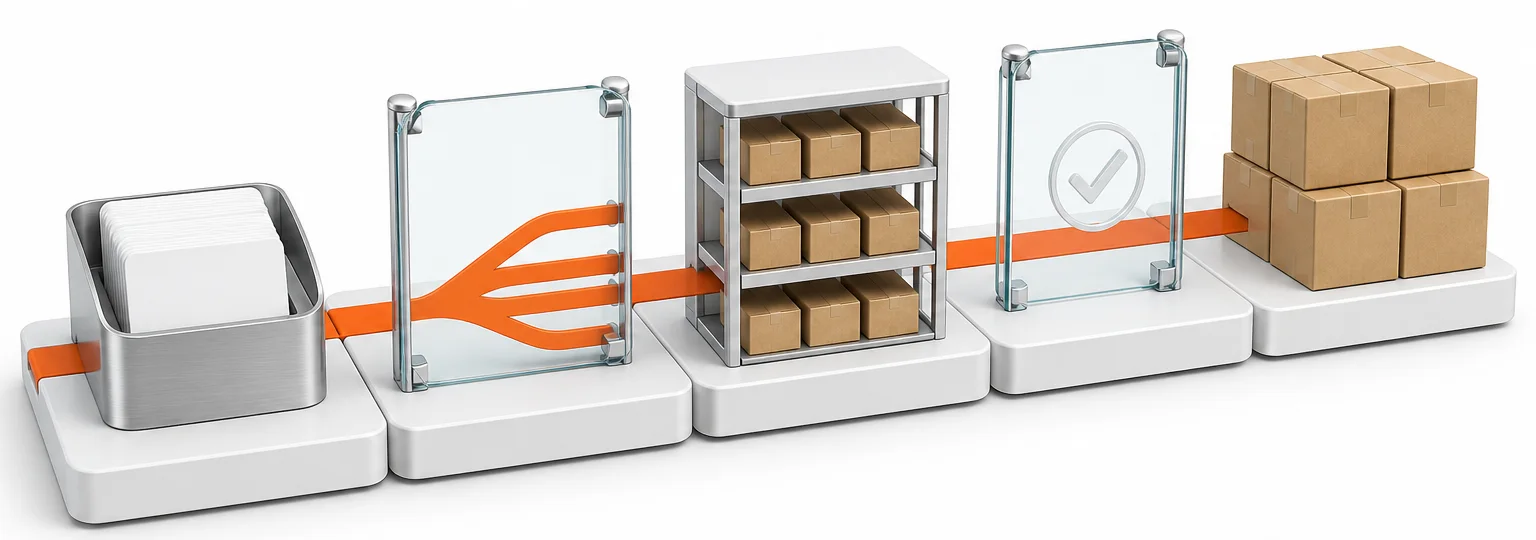
What you sell, where you sell it, and what breaks between channels today.
Platform, catalog model, and every integration mapped before any code.
Store, portal, and agents built against your real data on a short cycle.
Data moved with a 301 map, so rankings and order history survive cutover.
We stay after launch: monitoring, fixes, and the next channel you add.
Before you sign, you see it work. For a store, we build a draft theme in your own store. For an AI agent, we build a demo that runs on your sample files and rules.
Ask for a demo ↑Real clients, real sites, all live today. Open any of them, then read how we built it.
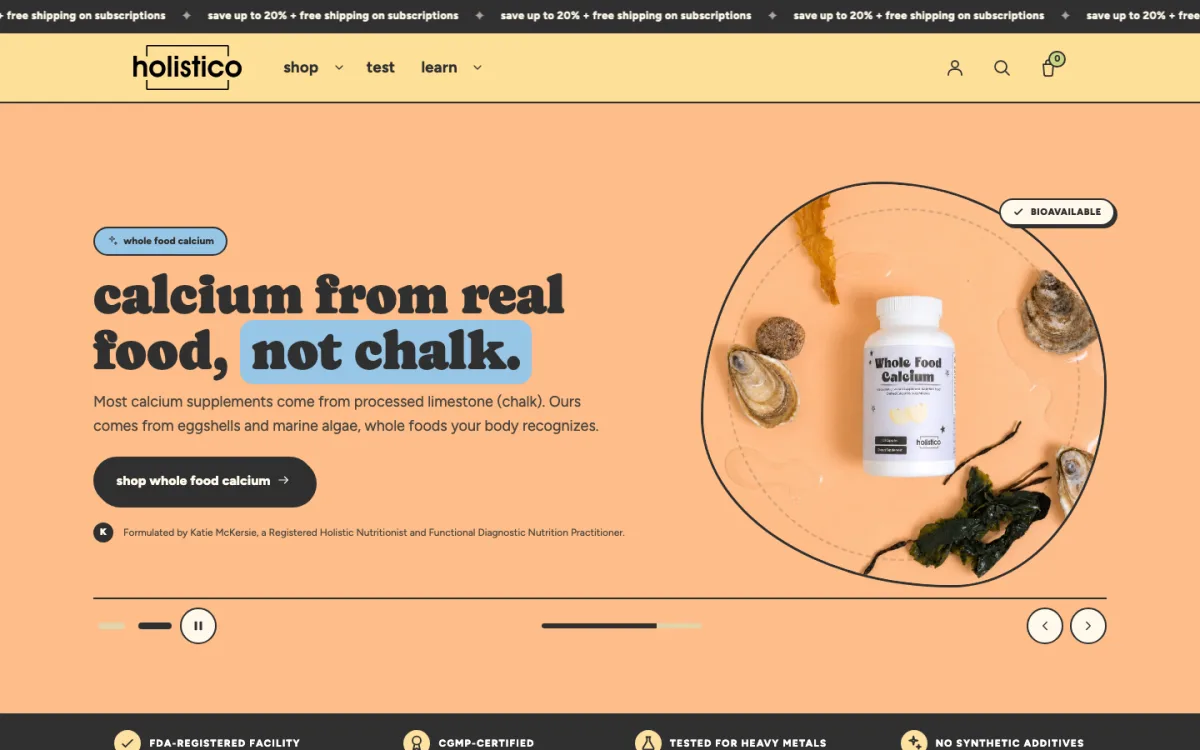
A custom Shopify theme for a whole-food supplement brand selling across the US, with subscribe-and-save plans, bundles and two landing pages built for Meta ads.
An AI agent that finds serious crashes involving commercial vehicles in published news and police sources, checks the facts, and alerts the firm by email. Live, running every two hours.

A large business website for a signage and fit-out company, with service, case study and insight pages built so search engines and AI answers can read them.
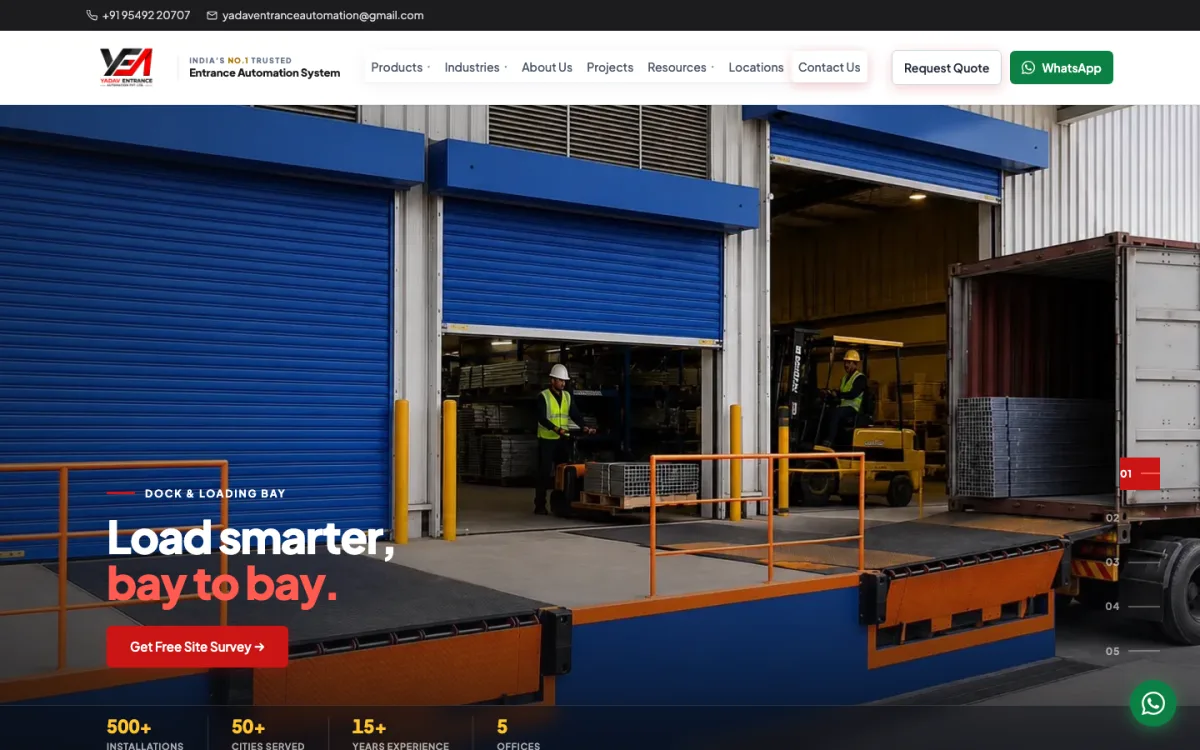
A website built from scratch for an entrance automation manufacturer, covering 16 product lines, with SEO and AI search work that continues after launch.
More work: Flying Pixel (drone survey company), RDB Travels (cab hire), Belle Maison (retail and trade store). See all case studies
We work remotely with brands across the United States. Pick your industry or your city for the detail that applies to you.
Commerce, websites, and AI agents built around how each industry sells.
Real questions, direct answers. If yours isn't here, send a short brief.
We design, build, and implement the systems that let you sell across your store, marketplaces, and B2B from one catalog, one inventory, and one order engine. In plain terms, we are the team you hire to build unified commerce, not a tool you subscribe to.
Omnichannel is about the customer experience across channels. Unified commerce is the architecture underneath it that keeps products, inventory, orders, and customers in sync in real time. We build that unified layer so your channels stop drifting apart.
An agency. We are a services partner that consults, designs, develops, and implements commerce for you. You own and operate what we build, and there is no FactoryJet subscription.
Both. Most of our work is improving or replatforming what you already run, then adding the unified layer. We audit what you have, fix what is broken, and build what is missing.
Ecommerce development is the work of designing, building, and connecting an online store: the storefront, checkout, product catalog, and payments, plus the integrations to your inventory, ERP, marketplaces, and shipping. An ecommerce development company does that work on a platform like Shopify, Adobe Commerce, BigCommerce, or WooCommerce, then supports the store after launch.
An ecommerce agency is a team you hire to build, fix, or grow an online store. Some only design themes and some only run ads. A full-service ecommerce agency like FactoryJet covers design, development, integrations, B2B ordering, and SEO, so one partner owns the whole system instead of five vendors each owning a piece.
The best one for you is the one that has already built something like your store. Check four things: comparable builds on your platform, real B2B and integration experience if you need it, who supports the store after launch, and whether they commit to a fixed proposal. Directories like Clutch list reviewed agencies. Ask each firm on your shortlist for two clients you can call.
There is no single best one; it depends on your catalog size, B2B rules, and budget. We build on Shopify and Shopify Plus, Adobe Commerce (Magento), BigCommerce, WooCommerce, headless, and our own Commerceflo, and recommend the fit rather than pushing one platform.
Shopify Plus for speed and a clean DTC-plus-B2B model on one store, Adobe Commerce for deep native B2B and very large catalogs, BigCommerce for strong mid-market B2B value. We match it to your SKUs, pricing rules, and integrations on a scoping call.
Yes. We handle replatforming and data migration, products, customers, orders, and B2B pricing, with 301 redirects and a cutover plan that protects your rankings and uptime.
Yes. We integrate ERPs, POS, 3PLs, and marketplaces into one order and inventory layer so every system reads the same live data instead of its own copy.
Setting up a store yourself on a hosted platform starts around $29 a month. An agency build on Shopify, WooCommerce, or BigCommerce usually costs $2,000 to $25,000, and custom or headless builds start around $25,000 and can pass $250,000, based on Shopify's and BigCommerce's own 2026 cost guides. B2B pricing rules and ERP integrations push a build toward the higher end. We scope yours on a short call and send a fixed proposal before any work starts.
US and Canadian Shopify agency rates run about $120 to $200 an hour, and a professionally built custom Shopify store for a US small business typically costs $2,000 to $6,000 one-time plus the monthly Shopify plan. Shopify Plus, B2B, and ERP integrations cost more. Price comes from scope, not hours, so ask any agency for a fixed proposal.
Yes. That is most of what a Shopify development agency does. We design and build Shopify and Shopify Plus stores, migrate your products, customers, and orders, and connect the store to your inventory, marketplaces, and ERP. The store and the Shopify account stay in your name, so you own everything we build.
Yes. We connect Shopify to QuickBooks so orders, customers, payments, and refunds post to your books without re-keying, and so one inventory count feeds every sales channel. Depending on your workflow we use an existing connector app or build a custom integration, and we tell you which one fits before any work starts.
Yes. Your WordPress site can stay as the main website while Shopify handles the product catalog, cart, and checkout. The two common routes are a Shopify storefront on a subdomain such as shop.yourbrand.com, or Shopify products embedded in your WordPress pages. We recommend one after looking at your catalog size and how much of the buying journey lives on WordPress today.
You put every channel on one catalog and one live inventory, so a sale anywhere updates everywhere. We build that connection plus the listing, pricing, and order flows each marketplace expects.
Overselling happens when each tool keeps its own stock count. We build a single live inventory that every channel reads from, so when the last unit sells on one channel it goes unavailable on the rest within moments.
Yes. We build one storefront that serves retail shoppers and gives trade buyers their own login with tiered or contract pricing, net terms, and fast reordering, on one catalog and inventory.
Tiered and contract pricing, quote and approval workflows, account hierarchies, net terms, gated catalogs, and reordering, all integrated with your ERP.
A B2B ecommerce agency builds online ordering for manufacturers, wholesalers, and distributors: account-specific pricing, quote requests, net terms, bulk and repeat ordering, and ERP integration so orders flow straight into the back office. We build B2B portals on Shopify Plus, Adobe Commerce, BigCommerce, or Commerceflo, often on the same catalog as a DTC store.
Yes, and the technology is mature now. We build and implement agents that sync inventory, reprice to hold the Buy Box, and keep listings consistent across channels, all acting on your live data.
The repetitive channel work: listing new products in each marketplace's format, fixing suppressed listings, repricing, reconciling feeds, and answering order questions. They take the busywork off your team, not the strategy.
No. These are task agents that take action across your channels, listing, pricing, and inventory, not a question-and-answer widget on your site.
We build and implement them into your stack; they run inside your system and hand the exceptions to your team. You stay in control of the business.
An AI development company builds software that uses AI models to read information, make a decision, and take action inside your business: agents, integrations, and automations connected to your ERP, CRM, store, and support desk. FactoryJet builds custom AI agents with a human approval step wherever the decision matters, and you own the code and the agent.
Custom AI agent development runs about $5,000 to more than $180,000 depending on complexity, according to development firm ProductCrafters' 2026 breakdown, and most well-scoped projects reach a first production deployment in 3 to 12 weeks. A single-task agent on one system sits at the low end. Agents that work across several systems, with approvals and monitoring, sit higher. We scope to a fixed outcome, not an hourly meter.
Agentic commerce is buying and selling where AI agents do part of the work. A shopper's assistant searches, compares, and sometimes checks out, while a brand's agents keep listings, prices, and stock accurate. For a store, it means your product data has to be clean and machine-readable, because an AI assistant is more and more often the first thing that reads it.
No. AI is changing how people find and choose products, not removing the need for a store. Shoppers increasingly start in ChatGPT, Perplexity, or Google AI Overviews, and those assistants still send them to a real product page and checkout. What changes is that your product data, reviews, and page structure have to be readable by AI, not just by people.
Yes. A quoting agent reads the request for quote, looks up your price book, material costs, and past quotes, applies your pricing rules, and drafts the quote with the rule behind each line. A person approves it before anything is sent. It works best when your pricing rules can be written down. If pricing is mostly judgment, the agent prepares the draft and your estimator decides.
Buy a product when the job is common, like answering order questions, and the tool already connects to your systems. Build a custom agent when the work depends on your own rules, such as a price book or approval limits, or when it crosses several systems that no single product covers. On a scoping call we say so when an off-the-shelf tool is the better buy.
We do, under a support plan. That covers monitoring the agent's decisions, fixing failures, updating prompts and models as providers release new versions, and adding rules as your process changes. You own the code and the agent, so you can move support in-house or to another team later.
An AI SEO agency works to get your brand named and cited in answers from ChatGPT, Claude, Gemini, Perplexity, and Google AI Overviews, while your pages keep ranking in classic Google results. The work is also called generative engine optimization (GEO) or answer engine optimization (AEO): answer-first pages, schema, open AI crawler access, and mentions on the sites AI assistants trust.
When an agency runs it, generative engine optimization costs about $1,500 to $5,000 a month for most small businesses and $5,000 to $25,000+ for mid-size companies, according to WebFX's May 2026 pricing guide. One-off audits run $5,000 to $50,000. You can see where you stand first, for free, with our AI Visibility Checker.
Yes, but it has changed. Google still sends most search traffic, and AI assistants often build their answers from pages that already rank. What stopped working is thin pages written around a keyword. Pages that answer real buyer questions directly, cite their sources, and show real experience now win in Google and in AI answers.
A web design company plans, designs, builds, and launches your website: page structure, visual design, development, speed, and SEO basics, and usually hosting and support after launch. FactoryJet designs custom websites and redesigns for B2B and service businesses, built to load fast and structured so Google and AI assistants can read them from day one.
A US small business website costs roughly $500 with a DIY builder up to $25,000+ with a premium agency in 2026, and most custom professional sites land between about $2,000 and $8,000. Ecommerce and B2B sites cost more because of the catalog, checkout, and integrations. Ask for a fixed proposal that lists every page and integration.
No. AI tools now draft layouts and code quickly, but they don't know your buyers, your offer, or why someone should call you instead of a competitor. The job has moved from pushing pixels to strategy, content, speed, and conversion. Good web design teams use AI to move faster, not to skip the thinking.
Ask about their B2B experience specifically, their discovery and scoping process, how they handle integrations, who owns the relationship after launch, and to see comparable builds. We are happy to answer all of those on a call.
Most mid-market builds and migrations run from a few weeks to a few months, depending on custom integrations and catalog complexity. You get a phased timeline with milestones after scoping.
Yes, most of the brands we work with are US-based, across DTC and B2B, and we bring a decade-plus of commerce builds to every engagement.
Yes. Before you sign, we show you working software built on your own data. For a store, that is a draft theme set up in your own store. For an AI agent, it is a demo that runs on your sample files and rules, so you can check its output against a job you have already done by hand. You decide after you have seen it work.
We'll map your channels, catalog, and B2B into one system, and show you which work the agents can take off your team's plate. You get a fixed proposal before any work starts.